Organizational Benefits of the Purchasing Invoice Resolution Queue
Why the Purchasing Invoice Resolution Queue is Essential to an Optimized Yoga for FSM Installation
What is the Purchasing Invoice Resolution Queue?
What is so Important about working the Purchasing Invoice Resolution Queue
Implementing Buyer Notification Messages
Organizations use Yoga for FSM because it’s a solution that fits seamlessly with Infor and is built specifically for the types of Accounts Payable challenges organizations often experience. And Yoga for FSM fits that need extremely well – boasting pre-configured automated workflows and validation rules, and most importantly, providing a centralized interface where users can manage invoices, exceptions, centralized communications throughout the cycle, and supporting documentation. If you are viewing this article, we hope you can agree!
Automation only gets us so far, however, and the clients that see the biggest return on their Yoga investment share a common theme – Buyers and Accounts Payable staff collaboratively working together in one centralized location to ensure that when invoices have discrepancies or errors that require manual intervention enter the system, they are dealt with swiftly and appropriately. That’s where the Purchasing Invoice Resolution (PIR) queue comes in.
What is the Purchasing Invoice Resolution Queue (PIR)?
The PIR queue is one place in Yoga for FSM that non-Accounts Payable staff will work and is a holding area for invoices that have errors, such as Missing / Invalid PO, Missing PO Line, or PO Vendor Mismatch. In the past, these types of errors typically had to be dealt with outside the system, usually through a cumbersome back-and-forth email or phone call process.
In Yoga, this process is now as simple as opening a document in the queue, clicking the Notes button on the top right of the page, and reviewing what the AP staff member entered as the error code.

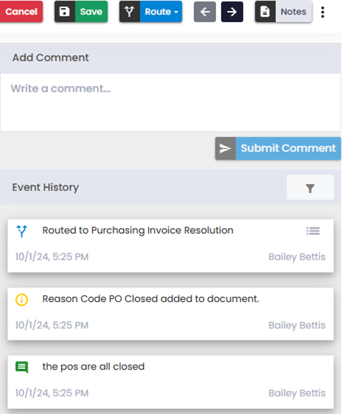
From there, it is a similar process:
- Researching in Infor for the root cause
- Submitting a comment on the document in Yoga once next steps are determined
- Routing invoice back to Accounts Payable for AP to continue processing the invoice.
By having the PIR queue directly in the front-end processing system alongside other Accounts Payable invoice queues, Yoga for FSM introduces an easy and intuitive way for Buyers to see notes from Accounts Payable, as well as the original invoice image and any supporting documentation. This process, while still manual, should be greatly improved as the ease of communication heightens.
What is so Important about working this Purchasing Invoice Resolution Queue?
Below are some of the most important reasons to work the queue:
- Maintain good relationships with your vendors by decreasing issue resolution time
- Timely procurement of future goods, services, and supplies
- Maximize the amount of quick-pay discounts captured
- Fast resolution of discrepancies ensures accurate financial records
- Elimination of on-hold risk
- Audit and compliance tracking
- Cost control and loss prevention with the central location for invoice communications
- Accrual accuracy. Aged volume sitting in PIR distorts the open AP accrual figure that leadership reviews at month-end.
Roles and responsibilities
In our experience, the single most common reason a PIR queue ages is not a system issue and not a staffing issue. It is an unresolved question about who owns the resolution.
|
The governing principle The department that owns the upstream document owns the resolution. Accounts Payable owns the invoice. Supply Chain owns the purchase order. When an invoice cannot post because of a defect in the PO — missing, invalid, wrong vendor, missing line — the owner of the PO resolves that defect, including any vendor contact it requires. |
O = owns the outcome. S = supports on request. A = automated in Yoga.
|
Activity |
AP |
Supply Chain |
Notes |
|
Invoice ingestion, capture, and indexing |
O |
— |
Email, scan, EDI, manual intake |
|
Automated PO match and validation |
A |
A |
Yoga validation rules; no human step |
|
Assigning the reason code and note before routing to PIR |
O |
— |
Specificity here is the largest single driver of turnaround |
|
Routing an invalid or missing-PO invoice to PIR |
O |
— |
Same business day it is identified |
|
Researching the PO defect in Infor |
S |
O |
The buyer owns the research |
|
Creating, correcting, or re-opening the PO |
— |
O |
AP generally has no authority here |
|
Vendor contact about a PO discrepancy |
— |
O |
No PO issued, wrong item, price or quantity dispute |
|
Vendor contact about an invoice document defect |
O |
— |
Illegible image, missing invoice number, remit-to, duplicate |
|
Posting a note and routing back to AP after the fix |
— |
O |
Same day the fix is confirmed |
|
Receipt and packing slip resolution |
S |
O |
Receiving owns receipt accuracy |
|
Posting to the ERP, payment, and month-end accrual |
O |
— |
|
|
Vendor master additions and changes |
O |
S |
Vendor Maintenance queue |
|
PO compliance: converting non-PO spend to PO |
S |
O |
A Supply Chain initiative, not an AP one |
|
Disposition of significantly aged invoices |
O |
S |
Joint where a PO defect is the blocker |
Days are calendar days from the point AP routes the invoice into PIR. The purpose of a ladder is to make it structurally impossible for an item to sit indefinitely waiting for someone to notice it. Adjust the intervals to your terms; keep the shape.
|
Day |
Action |
Owner |
|
0 |
AP routes to PIR with a specific reason code and a note stating what is wrong and what is needed |
AP processor |
|
3 |
Buyer posts a note with findings or a target resolution date |
Assigned buyer |
|
7 |
No buyer response — buyer’s manager notified in the note thread |
AP manager |
|
10 |
Escalation to Supply Chain and AP leadership |
Both leadership teams |
|
14 |
Joint decision: resolve, cancel, or route to analyst review for cleanup |
Both leadership teams |
Assignment
We would recommend naming an accountable primary and a named backup per commodity area or vendor group, with the remaining users as general access. This is a five-minute organizational decision that consistently does more for turnaround than any target.
Setting service levels for your organization
Clients frequently ask what the right PIR turnaround target is. The honest answer is that the number matters less than where it comes from. A target imported from another organization — or from a mature Yoga installation when yours is in year one — produces a dashboard that is red every day, and a team that learns within a month to stop reading it.
Start with your own distribution, not a benchmark
Before setting any target, spend four weeks measuring. From the Purchase Invoice Resolution report, capture:
- Inflow: how many invoices are routed into PIR per week.
- Outflow: how many are routed out per week.
- The age distribution of what is currently in the queue — median, 75th percentile, and oldest item.
- How many distinct users actually route items out, versus how many are provisioned. These two numbers are often very different, and the gap is usually the real constraint.
Those four measurements will tell you more about what is achievable than any external figure, and they give you a baseline to improve against.
Three commitments we recommend, in this order
|
Commitment |
Definition |
Why this one |
|
Clearance ratio |
Items routed out of PIR divided by items routed in, over the same period. Target 1.00 or higher; 1.10 while a backlog is being drained. |
The leading indicator, and the right first commitment because it is independent of your size. Below 1.00 the queue grows and no age target can hold. At exactly 1.00 an existing backlog is preserved indefinitely, which is why we suggest 1.10 until it clears. |
|
Share of the queue within target age |
The percentage of items in PIR aged at or below your target — commonly 14 days in year one. |
Moves the whole distribution rather than chasing a single percentile, and it reads directly off the aging bars on the PIR report. Set the first target a realistic step above where you are, then ratchet quarterly. |
|
Oldest item in the queue |
A hard ceiling on the age of any single item. |
The escalation-discipline metric. A very old item is evidence the escalation ladder was never applied. This is the target we would keep tight regardless of organization size. |
Year 1 versus mature targets
These differ, and publishing both is what keeps a year-one number from reading as a ceiling.
|
Metric |
Year one |
Mature (12–24 months) |
|
PIR turnaround, 75th percentile |
7–14 days depending on volume |
5 business days or less |
|
Clearance ratio |
1.10 while draining |
1.00 sustained |
|
Share within 14 days |
A realistic step up from your baseline |
95% |
|
Oldest item |
30 days |
14 days |
|
Past-due dollars in PIR |
Declining month over month |
Zero |
A volume-tier reference
Offered as a sanity check on the targets your own baseline suggests, not as a substitute for it. Tiers are by monthly invoice volume; all figures are year 1.
|
Metric |
Under 5k/mo |
5k–15k |
15k–40k |
Over 40k |
|
PIR turnaround, P75 |
7 days |
7–10 days |
10–14 days |
14 days |
|
Oldest item in PIR |
21 days |
30 days |
30 days |
45 days |
|
Clearance ratio |
1.00+ |
1.00+ |
1.00+ |
1.00+ |
|
Vendor Maintenance turnaround |
3 days |
5 days |
5 days |
7 days |
|
One measurement trap worth settling before your first scorecard The Past Due indicator on the PIR report is due-date based: the due date has lapsed, or, for invoices with no due date, the invoice is older than sixty days by invoice or created date. It is a cash-risk measure, not a queue-dwell measure. A turnaround service level therefore has to be measured on PIR Age days in queue and on the aging buckets, not on the Past Due flag. Both belong on your scorecard, because they answer different questions: a fast queue full of already-late invoices and a slow queue full of fresh ones will look identical if only one of them is tracked. |
How RPI Can Help
Our mission as your partner is to ensure that you are using the Yoga for FSM system as efficiently as possible to reach your organizational goals. A major component of efficient system usage is quickly turning around invoices that are in the PIR queue. We are committed to increasing your visibility into this queue by starting to show monthly and quarterly the invoice count and dollar amount in this queue and keeping it as a regular indicator of system health discussion in our cadence of SaaS partnership meetings. If there are any points of concern, if the queue starts piling up, we will talk through that with you and give best-practice recommendations based on your unique organization.
Measuring it: the reports to use
The Purchase Invoice Resolution report in Yoga Reports V2 is the primary instrument for everything above. It provides snapshot KPIs including invoice count, dollars in queue, average PIR age, past-due count and dollars, and items routed to PIR today; aging buckets; top reason codes and top vendors; a queue detail table with reason, PO, buyer, and last note; and a User Productivity panel showing documents processed by user.
Two companion reports are worth adding to a regular cadence. Invoice & Processor Lifecycle shows daily ingest against outflow, which is where the clearance ratio becomes visible, and Vendor Maintenance operates the parallel vendor-data exception queue.
Access
Yoga includes a dedicated AP Supply Chain security group, which carries access to Purchase Invoice Resolution, Invoice & Processor Lifecycle, Vendor Maintenance, Duplicate Vendor, and the Packing Slip and Receipt Management reports. If you are bringing Supply Chain leadership and buyers into a shared review for the first time, confirm they are provisioned into that group beforehand — arriving at a meeting about shared visibility with half the room unable to open the report tends to undercut the premise.
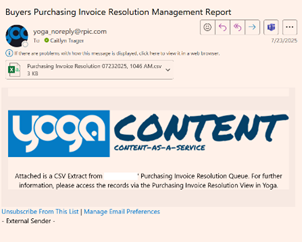
Most clients find they don’t need to work in the Purchasing Invoice Resolution queue daily but do like our customized system generated notification that alerts Buyers when there are records in their queue with awaiting review. If you are interested in this feature and don’t currently have this, please reach out to your support team and we will gladly implement this feature for you!
Even the small can be mighty, and while the PIR queue is just one relatively small area located in the larger Yoga for FSM tool, the impact it has on the overall success of your Yoga for FSM solution is undeniable.
If you have additional questions, please feel free to contact our Yoga Customer Success Manager, Heather Smith (hsmith@rpic.com), or your Yoga Consulting team.