![rpic-yoga_flexible_software-logo-color (1).png]](https://hubsupport.rpic.com/hs-fs/hubfs/rpic-yoga_flexible_software-logo-color%20(1).png?height=40&name=rpic-yoga_flexible_software-logo-color%20(1).png)
Table of Contents
How to Sign In
To sign into Yoga, you will use the default Yoga URL. Once logged in, you can switch between tenants as needed.
When first attempting to login, you might be greeted by the Yoga login page. After clicking on the Login button in the top-right corner, you’ll be taken to a Microsoft SSO page where you’ll fill in the necessary login and authentication information before being routed to your Yoga profile’s default tenant and view.


Capturing a Document
Most packing slips will be captured using the Yoga Connect Intelligent Email Capture or by scanning. Additionally, you may create receipt manually in Yoga. Below are the steps for Yoga’s Manual Capture:
- Navigate to the Left-hand Vertical Pane and select the Capture
- Select Add Packing Slip and you will be redirected to the Capture Page
- Either drag and drop a document image PDF file from your file system into the Drop Zone; or click on the Drop Zone and select a PDF file from your file system.

- The image(s) will populate in the initial PDF viewer.
- If the PDF has multiple pages, you can toggle through the pages below the PDF viewer.
- Users can also zoom in/out and rotate the image if necessary.
- Multiple receipts can be added to capture if needed.
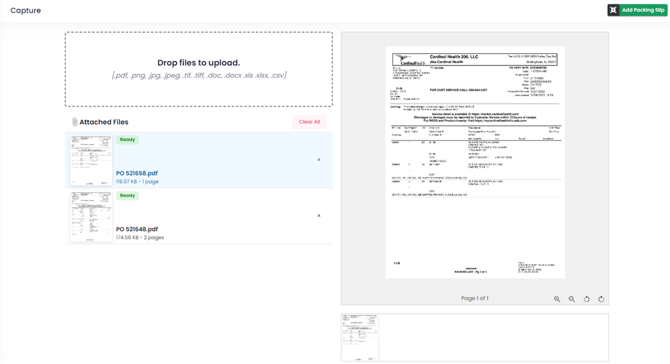
- You may click the green Add Packing Slip button in the top right of the page

2. If the document is uploaded successfully, you will see the ready status has changed to “Document created.”
Processing a Packing Slip
Once a packing slip has been captured via any of the three methods, it will be sent through OCR (optical character recognition) and the form fields will attempt to be extracted. Once it has gone through OCR, it can usually be found in the Packing Slip Review queue; otherwise, it might be in Packing Slip Error. All Views and their functions are contained in the below table.
(These queues are customizable by tenant)
|
View |
Function/Definition |
|
All Packing Slips |
This View shows all documents associated to the Packing Slip document type in the system |
|
Packing Slip Archive |
This View shows all documents that have been successfully posted to Infor FSM and IDM |
|
Packing Slip Cancel |
This View is where users can route documents that were scanned into the system but are not packing slips needing to be posted to Infor |
|
Packing Slip Error |
This View is where the documents that had issues extracting may be found. RPI is responsible for monitoring this view |
|
Packing Slip Review |
This View will be the primary view for all SCM users in Yoga. This is where all packing slips that have stopped in Yoga for review can be found, adjusted, and then posted to Infor |
|
RPI Review |
This View is where documents that were unable to be posted to Infor due to technical reasons may be found. RPI is responsible for monitoring this view |
Packing Slip Review
This view is where you will do most of your work in Yoga for FSM – Packing Slips. After a document has been captured and sent through OCR, it should end up here. This view contains a searchable and sortable list of slips that are awaiting review.

Clicking on a record in this view will redirect you to the packing slip form. You will need to fill out and/or correct the form with the receipt information so it can be posted to Infor. All required fields to enable routing will be indicated by a * symbol next to the label.
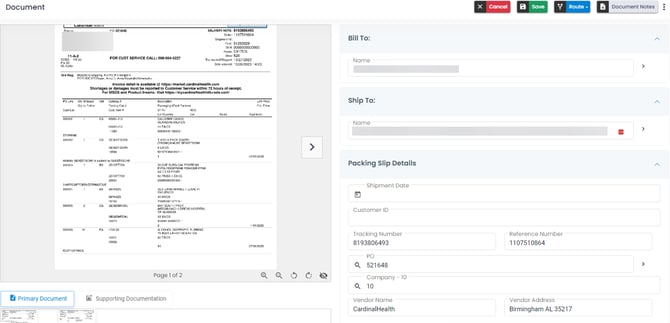
|
Field (bold = required) |
Value (to be entered) |
|
Bill To Name |
Bill to Company on Packing Slip |
|
Bill to Address |
Bill to Company address on Packing Slip |
|
Ship to Name |
Ship to Name on Packing Slip |
|
Ship to Address |
Ship to Address on Packing Slip |
|
Shipment Date |
Date of shipment on Packing Slip |
|
Customer ID |
Customer ID (if available) on Packing Slip |
|
Reference Number |
Order Number / Reference Number on Packing Slip |
|
Tracking Number |
Tracking Number or ID on Packing Slip |
|
PO |
Purchase Order Number on Packing Slip (populates the additional PO data in rollup if valid PO |
|
Legacy PO |
|
|
PO Code |
|
|
PO Open Amount |
|
|
Buyer |
|
|
PO Vendor |
|
|
Company |
Defaults from PO Master Data selection |
|
Vendor Name |
Vendor Name extracted on Packing Slip |
|
Vendor Address |
Vendor Address extracted on Packing Slip |
Document Viewer
From the Document Viewer, users will have the ability to visually manipulate the receipt. Each queue will have a Document Viewer area when opening a receipt.
- Navigate to the Packing Slip Review tab in the Left-hand Vertical Pane
- Open your document.
- On the left half of the screen, you’ll see the PDF Document viewer.
- Using the icons in the bottom right corner of the PDF viewer, you can zoom in, zoom out, rotate counterclockwise, rotate clockwise and view/not view the extraction areas of the document.
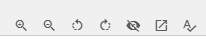
- You can also view all your pages of a multi-page document below the Document Viewer. Hop between pages by selecting the needed page below the Document Viewer or using the arrows off to each side of the Document Viewer.
- Values in the pdf surrounded by a blue box are items that were attempted to be extracted via OCR and mapped to the receipt form. Hovering over these values, you'll be able to see what the system thought that value is and the confidence of extraction. If the confidence is below a certain threshold, the value might not be posted to the form.
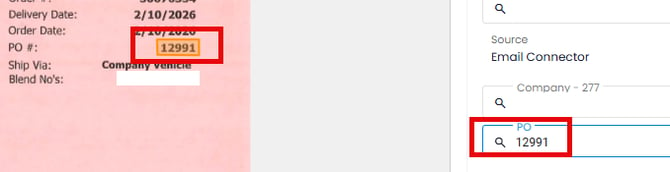
- Users can utilize the form on the right-hand side of the page to find the value on the PDF itself. Simply select inside a field (Example: PO Number) on the form itself. Review the pdf on the left-hand side for a value with an orange box around it. This is the value that was selected from the receipt to populate this field.
- Note - you must be on the page the value was extracted from for the orange to appear. If on page 2 but extraction was page 1, navigate to page 1 to review
- Users can also manually pop the image out of the page to a new tab to allow for more form real estate. If you'd like this to pop out all the time, take a look at the Profile setup portion of this guide! Select the pop-out icon to move the image to a new tab.

- In rare cases of the text showing up a little funky on your receipt, this usually indicates that the vendor has a font on their receipt not supported by your device. Select the Font Adjuster button. This will render those parts of the receipt to a designated backup font supported by all devices to render correctly.

Text Extraction - Lasso Tool
All OCR’d documents in the system have the ability for users to pull data directly from the pdf viewer to the eForm on the right-hand side of the screen. This helps limit the risk of manually keying values on the eForm in the system.
- Select inside a date, text, number, or popup field
- Select and hold CTRL on your keyboard
- You should see a note appear in the pdf viewer and different values extracted highlighted in yellow

- You should see a note appear in the pdf viewer and different values extracted highlighted in yellow
- Select the value or drag a box over the values needed within the pdf viewer that you would like to populate in the selected field.
-
- The value then appears in the eForm field selected. Selecting inside the field will now make the new selected value appear with an orange box.
Form Changes
Within Yoga, Super Users and other designated groups may have the ability to track form changes on records in their system, similar to how the audit log or history changes works in your ERP. These are two places' users can go to grab these changes
- Open document notes, scroll down to a Form Update box. This box appears each time the form has been updated and what the updates made were. You can also see the date/time and user that performed the update.
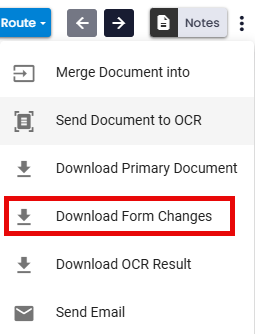
- Select the 3 dots in the upper right-hand corner, select Download Form Changes to download a CSV of all form changes made to this document over time.
Back to Top
Routing
From the Packing Slip Review window, users have the ability to route documents to different queues based on the document needs. Routing documents are customizable per tenant and are currently configured within the queues. Users will not be able to route documents until all required fields (indicated by a *) have been filled out unless the user opts to route without saving. See below how to route your documents to a different queue:
- Navigate to the Left-hand Vertical Pane
- Under the Views dropdown, select Packing Slip Review
- Towards the top right of the Packing Slip Review window, you’ll see four buttons: Cancel, Save, Route and Document Notes. Select the Route

- Here you can route the document to its correct queue to be reviewed by another resource, mark it as a duplicate, or whatever queue you may have set up.
(Depending what queues are set up for a particular tenant, they can depict where documents can be routed from what queue to what queues)
Document Notes
-
Document notes are a way for users to document any findings, concerns or questions following that document. This area will also track any routing taken place on this document.
- Navigate to the Left-hand Vertical Pane
- Under the Views dropdown, select Packing Slip Review
- Toward the top right of the Packing Slip Review window, you’ll see four buttons: Cancel, Save, Route and Document Notes. Select Document Notes

- A light gray panel will appear to the right of the PDF image viewer and Form Browser
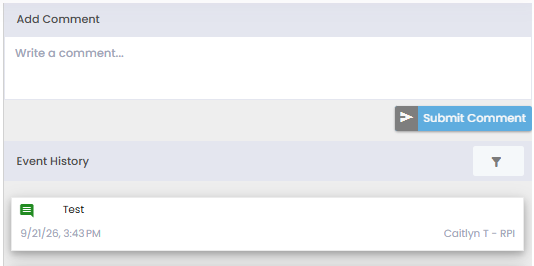
- Within the Document Notes pane, you can also track things like Routing, Failures, Information (reason codes), and form changes
- To filter to only see certain ones in this pane, simply select the filter button below the Submit Comment action and select the ones you'd like to see
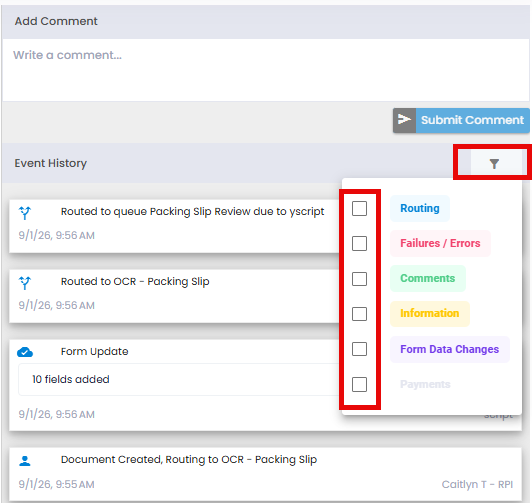
- Ones you have selected appear at the top. You can add or remove at any time and this update stays on your profile until you remove or change it

Canceling a Packing Slip
There may be instances where a document was ingested into the application that is not a packing slip and you don’t need to review it. That is where the AP Cancel queue comes into play. You can route this document to the queue where it will still be present.
- From the Packing Slip Review view, select your receipt from the list
- Select Invalid Packing Slip reason code at the top of the form

- Select the Route drop down in the top right and route the document to the Packing Slip Cancel queue:

- This document will leave the Packing Slip Review queue and move to the Packing Slip Cancel queue where the document is still able to be viewed but doesn’t require review.
Back to Top
Splitting a Document
There may be times when you need to split a multi-page document to be their own pages. Follow the steps below for Document Splitting
- Navigate to the Packing Slip Review queue in the Left-hand Vertical Pane
- Select your multi-page document.
- You should be able to see the different pages of the document below the PDF viewer.
- In the top right-hand corner of the document, select the three vertical dots, select Split Document

- The Split Document window appears. Within this window you can split up multiple or individual pages of a document
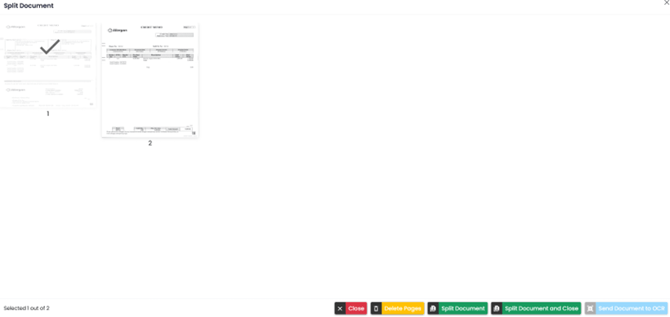
- When you split a document, you’ll select which queue to route the pages to.
- If your final document pages need to be sent back to OCR, you can also select the Send Document to OCR option, and it will route all remaining pages to OCR as a collective document. This option is unavailable if you have any documents selected, as you’ll need to use the Split Document or Delete Pages

Merging Documents
- From any view in Yoga for FSM – Packing Slip, open a record.
- In the top right-hand corner, select the three vertical dots next to the Document Notes and below your avatar.
- Select the Merge Document into

- Select the document that you need to merge the record into
- From the window, there are several ways to merge documents.
-
- Select Add all to and select Primary Document
- Select Add all to and select Supporting Documents
- Drag and drop pages to Primary Document
- Drag and drop pages to Supporting Documents
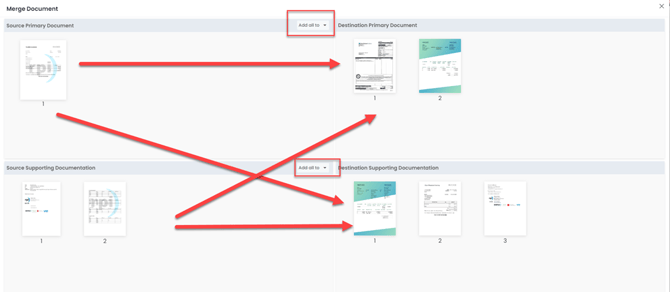
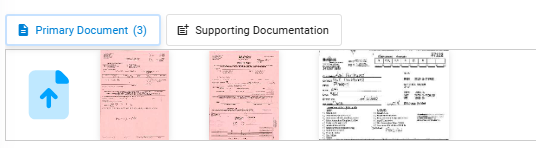
6. To move pages back to the original document, simply select the red X at the top of the thumbnail.
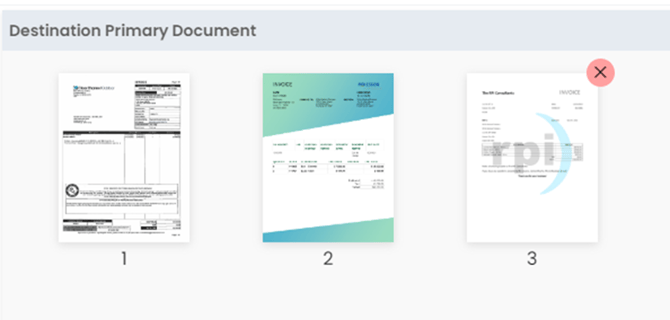
7. Once you have moved the documents to their correct location, select the green Confirm Merge button at the bottom of the window.
Reordering Pages
There may be times when you need to reorder pages in a multi-page document to be in a specific order. Follow the steps below to understand how to do so.
- Navigate to the Packing Slip Review in the Left-hand Vertical Pane
- Select your multi-page document
- You should be able to see the different pages of the document below the PDF viewer
- In the top right-hand corner of the document, select the three vertical dots, then select Split Document
- You should see two tabs at the top of the Split Document window: Primary Document and Supporting Documentation. Within the Primary Document page, drag and drop a page into a new position
- You should now see a blue rotate page symbol at the top of the pages moved
- The option at the bottom of the window now state Revert page ordering and Save page ordering

- Select Revert page ordering to put the pages back in order and the split document window options reappear
- Reselect a page and drag and drop into a new position
- Select Save page ordering
- The pages are reordered, and the split document window options reappear
Customize View
Within Yoga's application, you have the ability to custom each view available to your user group by view and by tenant (test and prod). These changes are personalized and will not be enabled for the overall organization, giving you the flexibility to have search filters based on your processing needs.
- At the bottom of a Yoga view, select Customize View
- Values selected are already available on your view page. Values not selected are available to add to your view page at any time. When a value is added, it will appear on the far left side of the view page.
- To quickly move something from the far right to the far left of the view, simply unselect and reselect that value
- Once all values needed are added to your page, you can begin to customize the look of this view. Simply drag and drop column headers to rearrange them in your preferred order
- To adjust the width, simply drag a column edge left or right to make bigger or smaller for viewing purposes
- Once you've filled the view space, a scroll bar will also be made available at the bottom of your view to help you utilize all columns added
Filtering and Sorting
You can use the filter and search options in each column to find specific receipts or sort them (e.g., from oldest to newest).
To see what filters or sorts are currently applied, select the View option at the top right. To remove all filters and sorts, click Clear in the same area.
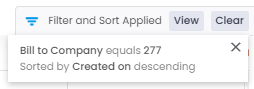
For date fields such as Received Date or Created Date, you can select the operator for Between to filter records within a certain data range. You also have the ability to select any of the preset date ranges like Last Month or Past 7 days.
On most columns, you also can sort for is empty (doesn't have a value) or is not empty (contains a value). This can be extremely useful when determining receipts to process where maybe key required fields, like Company or PO, weren't extracted or vice versa.
Reports
Reports in Yoga for FSM - Packing Slip provide a quick snapshot into your receiving environment and can be drilled down to the document level to quickly find documents that stand out in a filtered report. For more information regarding the current reports available in Yoga for FSM, please visit our Yoga FSM Reports Guide
Default View Overview
Top Right Corner
Clicking on your Avatar brings up your display name, email address and three options for you to select from: My Profile, My Tenants and Sign Out. Clicking on the tiles to the left of your Avatar does nothing.
My Profile
- Whenever you wish to view or change Personal or Account information, navigate to the Personal Settings page by clicking on the My Profile option. Here you can update your Avatar, Display Name, Email, and your Default View and Tenant.
My Tenants
- Each tenant is seen as a separate environment, and you can change between the PROD and TEST environments by clicking on the My Tenants option and selecting one.
Sign Out
- Signs you out of Yoga.
Updating your Default View
The Default View is the first page you see when signing into Yoga, so you may wish to update it to match what page you want to see. To update your Default View, follow the below steps:
- Click on your Avatar in the Top Right Corner
- Select the My Profile option – you should be brought to the Personal Settings page
- Navigate to the Account Information tab
- Here, you can select a View from the drop down for your Default View and click Save Changes
- If, for instance, you were to change it to the Packing Slip Review view, then the next time you log into Yoga you should see the Packing Slip Review view first.
- To see your final Default View changes, you’ll need to log out and log back into Yoga Content
Left-hand Vertical Pane
This pane is used to lock and unlock the pane, access Admin pages, as well as navigate to the Capture pages, other Views and various reports.
- When the pane is docked/locked, the stacked arrows (right of the Yoga Logo) will be pointing left – click these to partially hide the pane. When the pane is partially hidden, the arrows will be pointing to the right – click these to dock/lock the pane.
- Any items with white arrows, like Admin or Views, contain additional items – clicking on them reveals the additional items which you may select from.
Support Tickets
By clicking on the avatar in the top right, you will see Support ticket as an option. Support Ticket feature in Yoga for FSM allows you to easily submit, track, and manage support requests through the HubSpot Support Portal. You can create new tickets, check the status of existing ones, and communicate directly within the system. Below is a breakdown of how to use this feature effectively
Submitting a Support Ticket
You can submit a Support Ticket in two ways:
-
Through the HubSpot Support Portal
- Track the status of your tickets.
- Create new tickets for technical issues or questions.
- Access your tickets directly from Yoga, which links to HubSpot.
-
Via Email (yogasupport@rpic.com)
- Subject: Enter the ticket title.
- Body: Provide a detailed explanation with examples/images.
- Automatic Ticket Creation: Emails generate HubSpot tickets and assign them based on the sender's company email.
- Visibility: Tickets appear in Yoga > HubSpot for tracking.
- Communication: Updates and responses are sent via email, and you can reply directly through HubSpot or email.
Accessing HubSpot from Yoga
- First-time login: Create an account when first accessing HubSpot from Yoga.
- Sign-In > Register Account
- Use company email
- Sign-In > Register Account
- Auto-login: Future access will be seamless by clicking the HubSpot Support Ticket icon.
- Sign-in page: If prompted, you’ll be directed to sign in or register.
Tracking & Managing Tickets
Once a ticket is created, you can track it using:
Search & Filter
- Search: Find tickets by Subject or Ticket ID and press Enter.
- View: Filter based on ticket ownership. My tickets, displays tickets created by you.
- Status: Filter current progress of the ticket.
- Ticket ID: Unique reference number.
- Subject: Issue title/description.
- Date Created: Submission timestamp.
- Last Activity: Recent communication or updates.
- Status: Current progress of the ticket.